Fomo Copy Trading: What the Leaderboard, Feed and Alerts Really Give a Beginner
Fomo puts a leaderboard, a live feed and buy alerts on its front page instead of a chart. We read the app’s own copy-trading guide, its risk list and its fee page to see what that social layer is worth to someone starting out.
By The Hashmere Test Desk6 min read
7.4/107.4/10
Our verdict
Fomo makes the social layer the front door rather than a tab, and the parts that matter are the honest ones: a full trade history per trader instead of a self-reported return, and a beginner guide that names over-reliance as a risk. Alerts are fast enough to be useful in newly launched tokens, and nothing opens a position without you confirming it. The gap is cost — the trading fee is described everywhere and quantified nowhere.
Best for: Beginners who want to watch experienced traders in real time and still place every trade themselves
Leaderboard entries open into a trader’s complete trade history, not a self-reported percentage
Real-time alerts are fast enough to matter in newly launched tokens, where the useful window is minutes
Nothing auto-copies: every position still requires you to confirm it, which suits a beginner in a volatile market
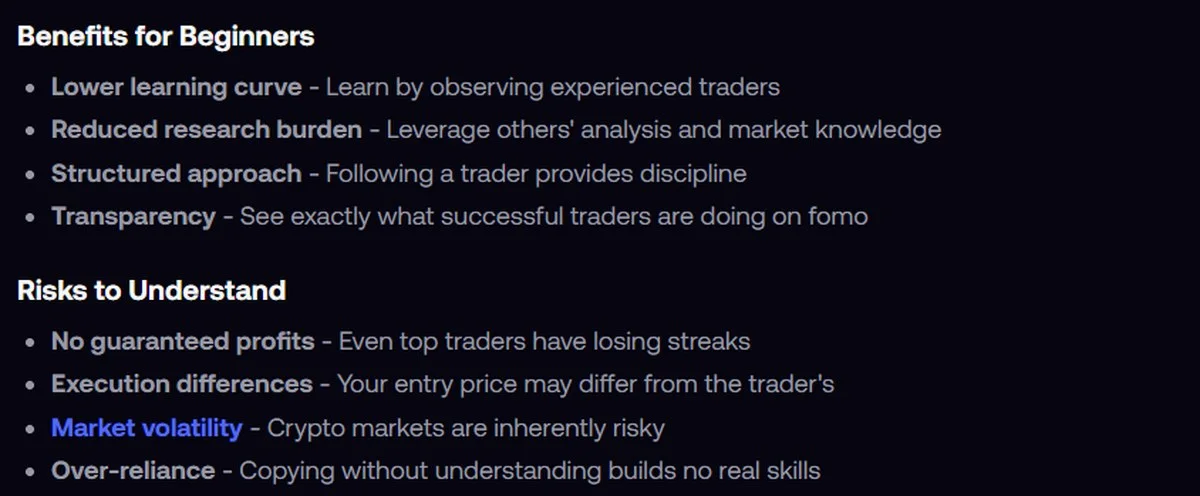
The app’s own guide names four risks, including that copying without understanding builds no real skills
Non-custodial wallet powered by Privy with no seed phrase; trades route through DFlow with MEV protection
Gasless multichain trading, Apple Pay funding from $25, and no fee on the first buy
Most crypto apps treat other people’s trades as a feature you can switch on somewhere in the settings. Fomo builds its front page out of them. Open it and the first things you meet are a leaderboard, a live feed and a stream of alerts telling you what the best-performing accounts just bought. That is the most interesting design decision in the product, and it is the one most worth thinking through before you fund an account.
The social layer is the product, not a bolt-on
FOMO Labs Inc. sums the app up in five words on its home page — where traders become legends — and splits its feature list into two groups of three. One group is about getting started: sign in with Apple or Google, multichain and gasless trading, one click to buy with Apple Pay. The other group is entirely social: a leaderboard, a feed and alerts that the company describes as real-time notifications for what the best traders are buying. The same page claims 2.5 million traders.
Plenty of apps bolt a copy-trading tab onto an exchange. Fomo inverts that: discovery through other people is the default view, and the trading screen is what you arrive at afterwards.
A leaderboard ranks people, and it only ever shows one side
The leaderboard is the clearest thing Fomo does well and the clearest thing a beginner can misread. It surfaces accounts with strong recent performance and, crucially, lets you open a trader’s complete trade history before you decide to follow them. That is a meaningfully higher bar than the self-reported percentages that float around crypto social media.
What it cannot do is show you the people who are not on it. A ranking of winners is, by construction, a survivorship filter. Fomo’s own explainer puts the caveat in plain language: even top traders have losing streaks. A ninety-day run at the top of a memecoin leaderboard is a real result, but it is not a forecast.
The feed turns a private decision into a public record
The feed is where the transparency claim earns its place. Fomo’s description is specific: you can see real-time trading activity, follow top performers, and analyse a trader’s full history before deciding to copy them. The order of those verbs matters. Seeing an entry as it happens is a notification; being able to scroll back through every entry and exit that trader has made is evidence.
Most beginners never get the second thing. On an exchange you see a price chart and your own balance. In a feed you see how often somebody trades, how long they hold, and how many of their positions went nowhere — which is usually the most educational number on the screen.
Manual — follow and confirm; no auto-mirror described
Trader data
Complete trade history viewable before following
Custody
Non-custodial wallet powered by Privy
Order routing
DFlow, with MEV protection
Sign-in
Apple ID, Google or emailed code; no seed phrase
Funding
Apple Pay, debit card or crypto; presets $25 / $50 / $100 / $250
Trading fee
A percentage per trade; rate not published
First buy
$0 fee
Network fees
Gasless; total cost shown upfront
Asset focus
Memecoins and newly launched tokens
Regulation
Not a licensed exchange or bank; no deposit insurance
Alerts are where the design earns its keep, and where it can bite
Alerts are the piece that actually changes behaviour. In newly launched tokens the useful window is measured in minutes, so a push notification the moment a followed account buys is worth more than a daily digest. Fomo is also honest that speed is not the same as sameness. Its guide lists execution differences as a named risk: your entry price may differ from the trader’s. Between their fill and yours sits the time it takes you to read the alert, open the app and confirm.
For a token that moved 40% in the hour, that gap is the whole trade. Treating an alert as a research prompt rather than a starting gun is the difference between using the feature and being used by it.
Fomo’s own explainer is unusually candid
The company publishes a beginner guide to copy trading that any affiliate-funded app could have written as pure marketing. It largely is not. It lists four benefits — a lower learning curve, a reduced research burden, the discipline of following a structured approach, and transparency into what successful traders are actually doing — and then four risks in the same size type.
No guaranteed profits — even top traders have losing streaks.
Execution differences — your entry price may differ from the trader’s.
Market volatility — crypto markets are inherently risky.
Over-reliance — copying without understanding builds no real skills.
That last line is the one most products would have cut. It argues against the frictionless version of its own feature, and it is the single best reason to take the rest of the page at face value.
Six rules the app publishes for beginners
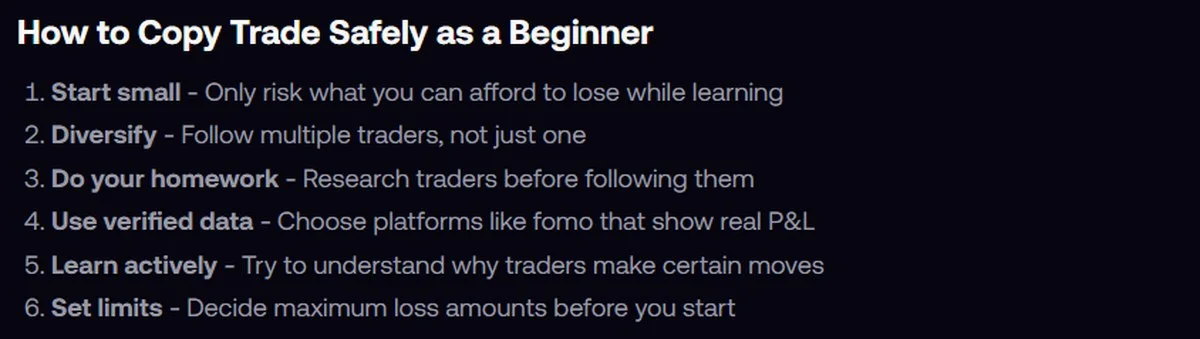
The same guide sets out a checklist, and it is a good one regardless of which app you end up using:
Start small — only risk what you can afford to lose while learning.
Diversify — follow several traders, not one.
Do your homework — research a trader before following them.
Use verified data — choose a platform that shows real profit and loss.
Learn actively — work out why a trader made a given move.
Set limits — decide your maximum loss before you start.
Rules two and six are the ones the interface does not enforce for you. Following a single spectacular account is exactly what a leaderboard invites, and no alert will tell you that you have reached your loss cap. Those remain your job.
Following is not the same as auto-copying
This distinction is easy to miss and worth being clear about. Nothing in Fomo’s public material describes a mirror that places trades on your behalf. What it describes is a sequence: you follow traders with a track record, you receive a notification when they buy or sell, and you choose to replicate the trade with your own capital.
That is slower than a mirror, and in a fast market that costs you price. It also means no position ever opens in your account without you pressing a button, which for a beginner in the most volatile corner of crypto is the right trade-off. If you were expecting set-and-forget, this is not that.
Getting in stays out of the way
The onboarding on Fomo is the least controversial part of the product. Sign-in runs through Apple ID, Google or an emailed code, with no seed phrase to write down; the wallet underneath is non-custodial and powered by Privy, and trades route through DFlow with MEV protection. Funding accepts Apple Pay, a debit card or crypto, with preset amounts of $25, $50, $100 and $250, and the first buy carries no fee. Trading is gasless and multichain, so a first-time user is not sent to buy a network token before they can do anything.
One number is missing, and it is the obvious one. Across the marketing pages, the fee explainer and a FAQ library of more than seventy entries, the trading fee is described as a straightforward percentage with no hidden spreads and gas included — but the percentage itself is never published. You cannot compare Fomo on cost before installing it; you find out on the confirmation screen of a small first trade.
Who the social layer actually suits
It suits someone who wants to learn by watching, has decided in advance how much they are prepared to lose, and is comfortable that discovery is happening through other people rather than through a screener. The full trade history, the verified and trending filters, and the liquidity and holder columns on each token are genuinely good tools for that person.
It suits nobody who wants a hands-off allocation. The catalogue is memecoins and newly launched tokens, the leaderboard shows survivors, and the app itself says copying without understanding builds no skill. Read that as the instruction it is, and the social layer is a decent place to start learning. Read it as a shortcut and it is an expensive one.
Risk warning
Fomo is a trading app, not a licensed exchange and not a bank. There is no deposit insurance and no compensation scheme behind a balance held in the app’s wallet, and because the wallet is non-custodial, recovery depends on the account you signed in with rather than on anyone’s support desk. Memecoins and newly launched tokens are among the most speculative assets available and can go to zero. Following a profitable trader into a position tells you nothing about their position size, their entry or when they intend to exit. Never commit money you cannot afford to lose.